Long response times
Business-critical processes may grind to a halt while tickets are queued, prioritised and passed between support teams.

AUTOMATION OPERATIONS · AUTOMATION MANAGEMENT
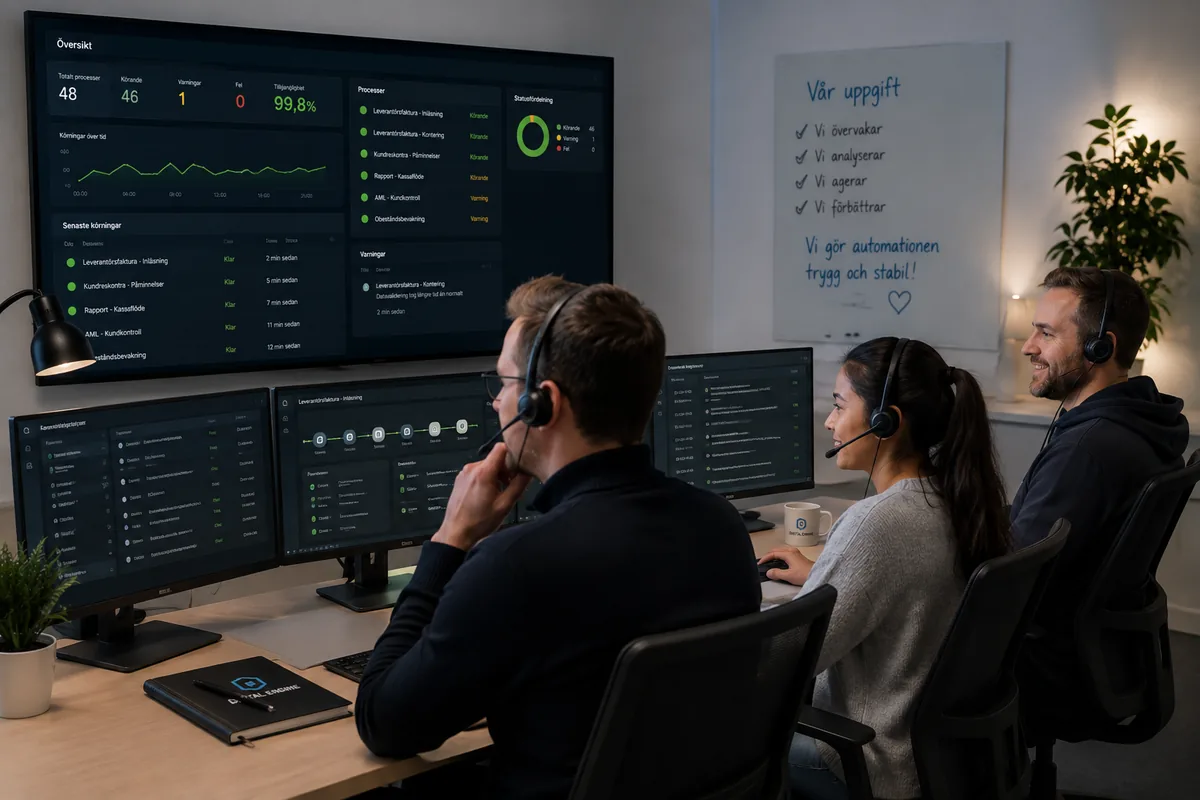
Digital Engine monitors and manages business-critical automated processes. We handle incidents, track dependencies on underlying systems and adapt automations when the business, systems or infrastructure change.
Customers gain a support function that combines personal contact and business understanding with established practices for monitoring, escalation, change management and follow-up. The aim is not simply to react when something goes wrong, but to build stability and reduce the risk of recurring issues.
THE CHALLENGES
Automated processes often span finance systems, integrations, infrastructure and external services. When responsibility is split across multiple parties, lead times can grow and no one has a clear overall view. Effective operations therefore need both to resolve incidents immediately and to understand why they occurred.
Business-critical processes may grind to a halt while tickets are queued, prioritised and passed between support teams.
A fault may lie in the automation, a finance system, an integration, an access permission or the infrastructure. If each party sees only its own component, troubleshooting takes longer.
Finance teams and process owners should not have to determine which supplier is responsible before they can get help.
When the focus is solely on closing incidents, the same failures can recur without addressing their root causes or weaknesses in the process.
Without established routines for monitoring, follow-up and change discussions, issues are often discovered only after the business has been affected.
Automation depends on accounts, permissions, infrastructure and integrations. Operations teams need to track changes and signals that may affect security, availability and performance.
OUR SERVICES
We can act as a specialist tier behind an established IT Service Desk, provide a single first-line point of contact for finance systems and automation, or support Digital Engine products and packaged processes.
Specialist support behind the customer’s own IT Service Desk. We handle automation tickets, monitor processes and coordinate with IT and process owners.
Learn more →A single point of contact for the finance function regarding finance systems and automation, including coordination with relevant system suppliers.
Learn more →Support and operations for our packaged processes and for Legal-Assistant, Office-Assistant and Proc-ezign.
Learn more →We analyse existing automations, recommend the right way forward and bring them into our managed service only once they are production-ready.
Learn more →OUR METHODOLOGY
Our operations methodology combines close day-to-day oversight with regular analysis and proactive monitoring. This gives finance teams, IT and process owners a shared view of automation health and the actions needed going forward.
Every working day, we carry out a structured review of the automated processes we manage. We focus on runs, deviations, incidents and issues that need attention before they affect the business.
Daily checks shorten the path from deviation to resolution.At a monthly meeting, we present how processes performed during the previous month. Together with the customer, we review stability, incidents and business or system changes that operations must prepare for.
Reporting makes operational performance and development needs visible to the customer.We continually develop monitoring of the dependencies automations need to function – including infrastructure, performance and relevant IT security signals. The aim is to identify risks earlier and reduce recurring disruption.
Being proactive means looking beyond an individual robot run.Before a new or existing automation enters regular operations, we conduct a joint quality gate with the customer. We ensure the solution is tested and production-ready, documented, accepted by the business and maintainable without dependence on individual developers.
Automation that is not production-ready does not enter regular operations.WHAT OUR CUSTOMERS SAY
A good support function should be accessible, communicative and understand how automation affects the business. Here are some of the things our customers say about our support.
“Quicker to respond than our own IT department”
“You can tell they really want to solve the issue”
“Easy to chat with on Teams”
“The monthly reports are great for seeing how things are going”
“They explain things well”
“Friendly”
LONG-TERM RESPONSIBILITY
An automation depends on processes, systems, integrations, permissions and infrastructure that change over time. We therefore work both reactively when something happens and proactively to keep solutions stable and relevant.
Continuous monitoring of runs, errors and deviations so issues can be detected early.
Structured analysis, escalation and resolution when an automation or one of its dependencies does not work as intended.
Minor changes when systems, integrations, infrastructure, regulations or business needs evolve.
Regular reporting gives customers visibility into operations, incidents and developments, providing a basis for continuous improvement.
FROM INDIVIDUAL INITIATIVE TO MANAGED AUTOMATION
Many organisations have automations developed through RPA, Power Automate, Excel macros or other local solutions. They can deliver significant value but become vulnerable when documentation, ownership, support and operations are missing as the solution becomes business-critical.
Automation Operations can stabilise, document, monitor and take over existing automations – even when they were originally built by the customer or another supplier. This transfers knowledge from individuals into a managed way of working.
Read about taking over existing automation →TECHNOLOGY-INDEPENDENT
Automation Operations is not limited to solutions developed by Digital Engine. We can also take responsibility for existing automation environments and processes built by the customer or another supplier.
This makes it possible to consolidate support, monitoring and operations even when the organisation’s automation landscape has grown over time and spans multiple technologies.
The focus is on keeping processes running in production – regardless of who originally built them.
AUTOMATION OPERATIONS
Tell us how your support and operations work today, and we can discuss which model best fits your organisation.
Contact us